
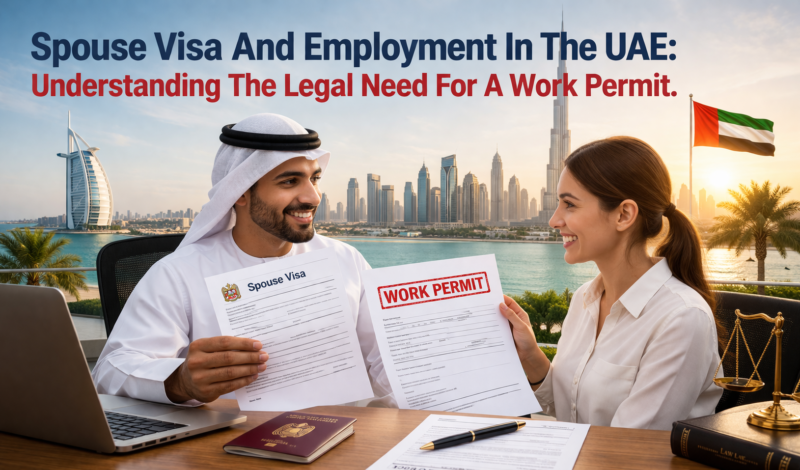

United Arab Emirates offers a flexible residency system that allows expatriates to sponsor their spouses and family members. A common question that arises in this context is whether a person residing in UAE on a spouse’s visa can legally work. While the short answer is yes, the legal framework imposes clear conditions, most importantly, the requirement of an employer-issued work permit.
This article explains what the law permits and why compliance with work permit regulations is essential.
Legal Status of a Spouse Visa in UAE
A spouse visa in UAE is a form of family-sponsored residence visa. It allows an individual to reside legally in the country under the sponsorship of their husband or wife.
However, it is important to understand that a residence visa only grants the right to live in the UAE. It does not automatically grant the right to work. Under UAE law, employment and residency are regulated separately.
Can You Work While on a Spouse’s Visa?
Yes, UAE law allows individuals sponsored by their spouse to take up employment. This includes both husbands and wives under family sponsorship. However, this permission is conditional. A person on a spouse visa may work only if:
- A licensed employer hires them, and
- The employer obtains a valid work permit from the Ministry of Human Resources and Emiratisation (MOHRE)
This is expressly required under UAE labour legislation.
Why a Work Permit is Mandatory
The requirement of a work permit is not procedural, instead it is a legal obligation.
1. a) Statutory Requirement
Under Article 6 of Federal Decree Law No. 33 of 2021 on Employment Relations, no individual may work in UAE without obtaining a valid work permit issued by MOHRE. This applies regardless of visa type, including spouse visas, family sponsorship visas, even Golden Visa holders.
The law further clarifies that every employee must have an official work permit issued through MOHRE, regardless of who sponsors their residency visa.
2. b) Separation Between Residency and Employment
UAE legal system distinguishes between:
|
Aspect |
Authority |
Purpose |
| Residence Visa | Immigration Authorities | Legal stay in UAE |
| Work Permit | MOHRE | Legal employment |
Therefore, even if a person is lawfully residing in UAE cannot work unless separately authorised.
3. c) Employer Responsibility
The responsibility to obtain the work permit lies with the employer. The process typically includes:
- Submission of employee documents
- Obtaining a No Objection Certificate (NOC) from the spouse sponsor
- Issuance of a formal employment contract
- Application through MOHRE systems (e.g., Tas ‘heel centres)
Consequences of Working Without a Permit
Working without a valid work permit is considered illegal employment in UAE. Under Article 60 of the law, legal consequences may include:
- Heavy fines ranging from AED 100,000 to AED 1,000,000
- Penalties against both employer and employee
- Labour bans or legal action
While the requirement may seem restrictive, it actually benefits both employees and employers as it ensures legal protection under UAE labour law, provides access to employment rights and dispute resolution, enables proper regulation of the labour market and allows flexibility without requiring a visa transfer.
Conclusion
Working in UAE on a spouse’s visa is legally permitted, but it is not automatic. The law clearly mandates that any individual engaging in employment must hold a valid work permit issued by MOHRE. Failure to comply with this requirement can lead to significant legal and financial consequences. Therefore, both employees and employers must ensure that proper procedures are followed before commencing employment.
At Ayesha Aldhaheri Advocates and Legal Consultants, we assist both employers and employees in navigating labour disputes, understanding labour rights, and ensuring compliance with UAE labour law. Our firm is ready to provide clear guidance and professional legal support.