
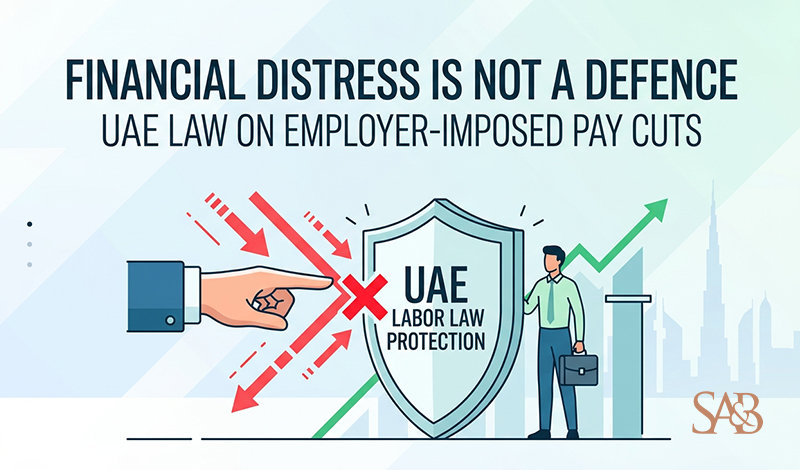

Economic fluctuations and business declines can place significant pressure on employers. In such situations, companies may consider cost-cutting measures such as salary reductions or placing employees on unpaid leave. However, under UAE law, these measures are not solely at the discretion of the employer. The law makes it clear that financial difficulty does not automatically release an employer from their contractual and statutory obligations toward employees.
The Principle of Contractual Stability
Employment relationships in UAE are fundamentally governed by contractual terms, strengthened by statutory protections under Federal Decree-Law No. 33 of 2021. Once agreed, the terms of employment, including salary, benefits, and working conditions, cannot be altered unilaterally by the employer.
Any modification to essential terms, such as a reduction in salary or a shift to unpaid leave, requires the explicit consent of the employee. Without such consent, the employer’s action may constitute a breach of contract, entitling the employee to file a complaint and seek remedies.
Salary Reductions: When Are They Lawful?
A salary reduction is legally permissible only under specific conditions:
- Mutual Agreement: Both employer and employee must agree to the revised salary terms;
- Formal Documentation: The change should be properly recorded, typically through an amended employment contract or addendum;
- Compliance with MOHRE Procedures: In many cases, the revised terms must be reflected in official labour records.
If an employer imposes a pay cut without consent, the employee retains the right to challenge the action before the Ministry of Human Resources and Emiratisation (MOHRE) and, if necessary, the labour courts.
Unpaid Leave: Consent Is Vital
Similar principles apply to unpaid leave. Employers cannot compel employees to take unpaid leave unless:
- The employee voluntarily agrees; or
- The arrangement is clearly provided in the employment contract and applied in compliance with the law.
Forced unpaid leave, particularly when used as a substitute for salary payment during financial hardship, may be treated as an unlawful practice.
Financial Difficulties: No Automatic Justification
A common misconception among employers is that financial strain justifies unilateral employment decisions. UAE law does not support this view.
Even in times of economic difficulty:
- Employers remain obligated to pay wages on time;
- Contractual commitments must be honoured unless lawfully amended;
- Employees’ rights to remuneration and benefits remain protected.
UAE courts and authorities consistently uphold the principle that internal financial issues cannot override employee rights. If a company is unable to meet its obligations, it must pursue lawful restructuring measures rather than impose unilateral changes.
Potential Legal Consequences for Employers
Failure to comply with labour law requirements may expose employers to multiple forms of liability:
- Labour Claims: Employees may file complaints to recover unpaid wages or challenge unlawful deductions;
- Administrative Penalties: Authorities may impose fines, suspend work permits, or restrict company operations;
- Compensation Orders: Courts may award damages for breach of contract or arbitrary actions.
In more serious cases, persistent non-payment of wages could trigger broader legal scrutiny, particularly where misuse of company funds is suspected.
Conclusion
Under UAE law, employers cannot unilaterally impose salary reductions or unpaid leave, even in times of financial difficulty. The legal framework prioritizes contractual certainty and employee protection, requiring mutual consent for any variation in employment terms.
Ultimately, financial hardship is not a legal defence for non-compliance. Employers must act within the boundaries of the law, ensuring that any adjustments to employment arrangements are fair, transparent, and mutually agreed.
We, at Ayesha Al Dhaheri Advocates and Legal Consultants, provides dedicated legal support in handling labour matters. Our firm has managed a wide range of employment disputes and achieved favourable outcomes for its clients. Our team is well-equipped to help employees, in full compliance with MOHRE regulations and the specific circumstances of each case.