
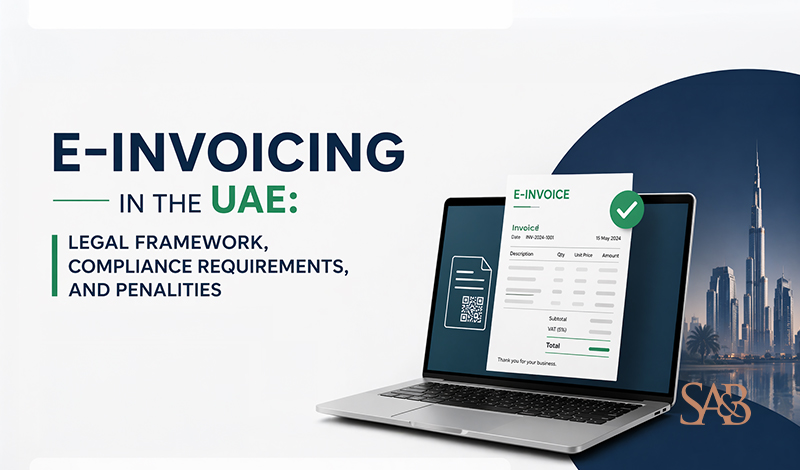

The introduction of the new e-invoicing system has been implemented with the aim of enhancing transparency, improving tax reporting, and significantly reducing paperwork, while streamlining financial transactions. E-invoicing is a smart digital invoicing system that operates through a structured system and is automatically reported to the government. Earlier, paper invoices were manually created either as paper documents, PDFs, or JPGs. This system is managed by the Federal Tax Authority. It applies to everyone conducting business in the UAE, regardless of their VAT registration status.
E-invoicing in the UAE supports the goals of the “We the UAE 2031” vision by strengthening digital infrastructure and improving government efficiency. It enhances tax compliance, transparency, and audit effectiveness while reducing manual processes and paperwork through greater automation.
A valid UAE E-invoice must:
- Be in a structured format which is XML for automatic processing.
- Be transmitted through approved plat form that is Accredited Service Provider (ASP).
- Be automatically shared to government for monitoring purposes.
- Be fully digital without using any manual formats.
Legal and Regulatory Framework in the UAE
The key regulations that govern E – Invoicing in the UAE are:
- Ministerial Decision No. 243 of 2025 – Establishes the Electronic Invoicing System (EIS) and core obligations.
- Ministerial Decision No. 244 of 2025 – Provides the implementation framework and rollout timeline.
- Ministerial Decision No. 64 of 2025 – Sets out eligibility and accreditation of Service Providers (ASPs).
- Cabinet Decision No. 106 of 2025 – Specifies violations and administrative penalties.
Implementation timeline
The timeline for implementation of the system of e invoicing will happen in phases. The phases are:
- 2025 – The U.A.E businesses could voluntarily exchange e-invoices over the Peppol Network. Reporting was not required during this phase.
- July 2026 – The mandatory framework kicks in from July 2026.Where all business must issue, exchange and report e -invoices. B2B, B2G and G2G e-invoices required as per PINT AE & TDD standards.
- 31st July 2026 – Companies with a revenue of AED 50 million and above must appoint an Accredited Service Provider (ASP). The government has given these companies 18 months advance notice to find and set up with an ASP.
- 1st January 2027 – All companies making AED 50 million or more must be fully live. They should completely adopt the e – invoicing system.
- 31st March 2027 – Smaller businesses and all government bodies. Smaller business and government entities have been given 24 months and 27 months respectively to full start running and hiring an ASP.
- 1st July 2027 – All businesses under AED 50 million must be fully live with digital invoicing by this date.
- 1st October 2027 – All government entities must be fully live with digital invoicing by this date.
Key Exclusions
- Government sovereign activities – If a government entity is doing work in its official government capacity and is not competing with private businesses, it is excluded.
- Airlines –
Three airline-related services are excluded:
- Passenger flights where an electronic ticket is issued.
- Extra services given directly to passengers where an Electronic Miscellaneous Document is issued.
- International cargo/goods transportation where an Airway Bill is issued but this is only a temporary exclusion for 24 months.
3. Financial services – Financial services that are VAT exempt are excluded from e – invoicing. Financial services provided to non-resident (foreign) customers that qualify as zero-rated exports are also excluded. However, if a financial service is standard rated when sold to a UAE resident customer, it is NOT excluded even if it qualifies as zero-rated for exports.
Penalties
Administrative penalties will be imposed if a person does not comply with obligations with respect to tax invoicing in line with VAT Decree-Law and the Tax Procedures Law. The penalties imposed under Cabinet Decision No. 106 of 2025 are:
- Failure to implement e-invoicing system – AED 5,000 per month or part of a month.
- Failure to issue or send e-invoices on time – AED 100 per invoice which could go up to a maximum of AED 5,000 per month.
- Failure to issue or send e-credit notes on time – AED 100 per credit note which could go up to a maximum of AED 5,000 per month.
- Failure to report system failure (by issuer or recipient) – if the system is down and the authority is not informed on time then a penalty of AED 1,000 per day of delay will be imposed.
- Failure to update information with service provider – If the service provider is not informed the details about the changes in business details, then there will be a penalty of AED 1,000 per day of delay.
In conclusion, the UAE’s e-invoicing regime marks a major shift to a digital, compliance-driven invoicing system. While it improves transparency, efficiency, and tax reporting, it also places strict obligations on all businesses regardless of VAT status. Businesses must adapt early to avoid penalties, operational issues, and compliance risks.
Our team at Ayesha Al Dhaheri Advocates and Legal Consultants provides legal support on UAE e-invoicing compliance, helping businesses understand requirements and prepare for implementation. We assist with system readiness, coordination with service providers, and integration of digital invoicing processes. We also help manage compliance risks and ensure a smooth transition to the new framework.