
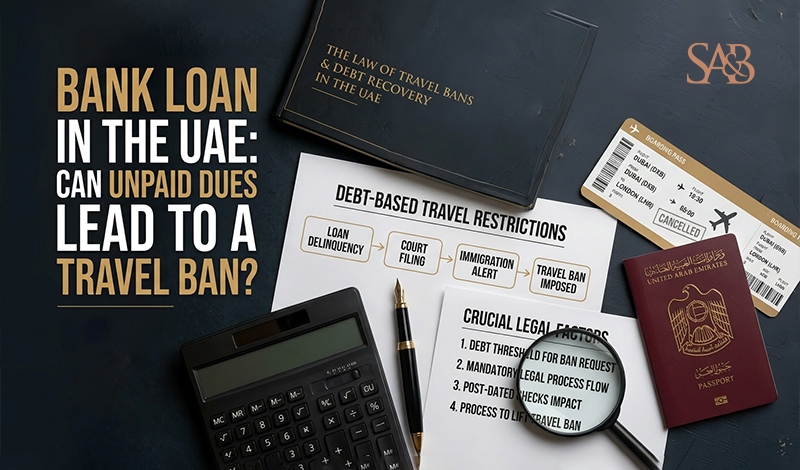

A lot of people have been facing financial constraints due to the current market situation. There are increasing instances of non-payment of dues, and people have been fearful about whether they would be directly subjected to a travel ban due to the non-payment of such dues. A very common misconception is that non-payment of dues automatically leads to a travel ban. The most important legal point is that banks or any other creditor do not themselves have the authority to impose a travel ban. A travel ban can only be ordered by a competent court or judicial authority upon an application made by the creditor (including a bank) and subject to the statutory conditions.
When can a creditor Seek a Travel Ban?
A creditor can apply for a travel ban even before filing a lawsuit – A bank or any other creditor does not need to wait until a full court case is filed but the creditor must show that the:
- There are serious reasons to fear that the debtor may leave the UAE.
- The debt is at least AED 10,000.
An exception for the ten thousand only apply in cases where the claims are relating to maintenance, commitments to perform work, commitments to refrain from work and work fees or wages.
The debt must satisfy one of two situations
- Fixed and due debt – The debt amount should be a known amount that is due for payment and does not depend on any future condition.
- Debt amount is not yet fixed – If the debt amount is not fixed then the judge can make a provisional assessment of the amount if there are proper written evidence and security from the creditor.
The judge may order the debtors passport to deposit with the courts treasury before or while issuing the travel ban.
Right to challenge the travel ban and medical treatment exception
The parties have the right to challenge the travel ban if granted by the debtor and if rejected then by the creditor.
The president of the competent court (or authorised representative) may allow travel despite the ban if the debtor or their close family members requires treatment abroad. This application must include an official medical certificate, proof that treatment is necessary abroad and proof that treatment cannot be provided in the UAE. This permission is temporary the travel ban itself remains in force.
When Does a Travel Ban End?
A travel ban continues until the debtor’s obligation to the creditor ends. However, the judge may lift the ban in the following situations:
- Conditions for the ban no longer exist – If the risk of the person travelling to another country or the debt requirement is no longer satisfied then the court can cancel the ban.
- Creditor agrees – If the creditor gives written consent the judge may revoke the travel ban.
- Debtor provides security – The debtor may provide a sufficient bank guarantee or a solvent guarantor approved by the judge.
- Debtor deposits money with the court – The debtor may deposit the debt amount; and relevant costs with the court treasury.
- Creditor does not pursue the claim – A travel ban cannot remain indefinitely the creditor should prove that the substantive claim was filed within 8 days of the travel ban order. The creditor after obtaining a final judgement must begin enforcement within 30 days if not the travel ban may be cancelled.
- Creditor remains inactive for three years – If three years have passed from the last valid enforcement step and the creditor does not request of execution then the travel ban will lapse.
- Debtor’s residence becomes illegal – if the debtors stay in UAE becomes illegal and the person must be deported and if the person has no assets in the UAE against which execution can be carried out then the travel ban may be lifted.
- Exception for Extradition Cases – A foreign national is being extradited to another country under the UAE’s international judicial cooperation laws in criminal matters in such situations the travel ban would be lifted.
Travel bans in the UAE are not automatically imposed due to non-payment of debts and can only be ordered by a competent court upon an application by a creditor and subject to statutory conditions. A creditor may apply for a travel ban where there are serious concerns that a debtor may leave the UAE and the legal requirements under the Civil Procedure Code are satisfied. Debtors have the right to challenge such orders, and courts may permit temporary travel in exceptional circumstances such as medical treatment abroad. Travel bans may be lifted when the debt is settled, adequate security is provided, the creditor fails to pursue the claim, or other grounds specified by law arise.
We at Ayesha Aldhaheri Advocates & Legal Consultants, we regularly assist clients in matters relating to travel bans and debt recovery proceedings in the UAE. Our team advises debtors on their legal rights, assesses the validity of travel ban orders, and represents clients in applications seeking the lifting or cancellation of such bans where the legal requirements are met.