
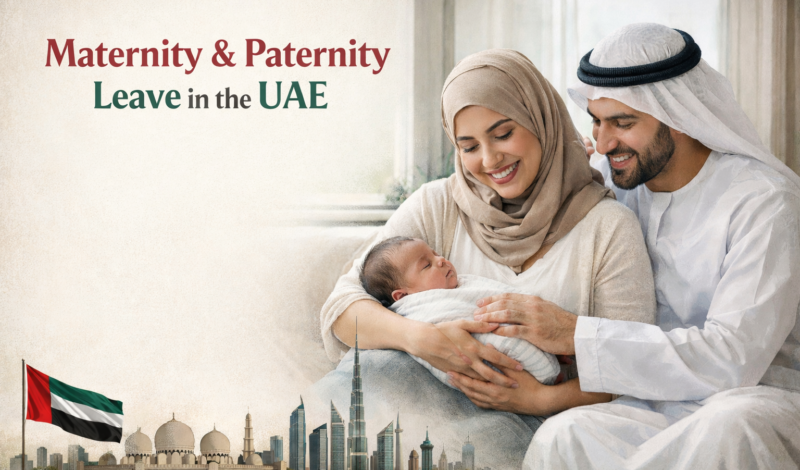

Under UAE labour law, maternity and paternity leave entitle employees to a paid time off to care for new-born children. However, the length of leave varies between the private and public sectors. In the private sector, employees are entitled to 60 days of maternity leave and 5 days of paternity leave. In the government sector, maternity leave ranges from 60 to 90 days and paternity leave from 3 to 5 days, depending on the applicable federal regulations. For private-sector paternity leave, employees must satisfy certain eligibility requirements.
UAE Federal Decree-Law No. 33 of 2021 guarantees maternity leave for all female employees in the country. This law applies to every working woman in UAE, including those employed part-time, under fixed-term contracts, or within free zones. Maternity leave typically includes a combination of fully paid days, half-paid days, and the option for unpaid extensions, whereas paternity leave is generally fully paid but shorter. Salary calculations are based on basic pay plus fixed allowances.
Duration of Maternity and Paternity Leave
The duration and conditions of maternity and paternity leave in UAE varies depending on whether an employee works in the private sector, which is governed by federal labour law, or in the public sector, which is regulated by either federal or emirate-level regulations.
- Under private sector
Under Federal Decree-Law No. 33 of 2021, female employees in the private sector are entitled to 60 days of maternity leave, consisting of 45 days on full pay followed by 15 days on half pay. In addition, if she suffers an illness related to pregnancy or childbirth that prevents her from returning to work, she may take up to 45 more days of unpaid leave.
If the child is born with a disability or a serious medical condition, the employee is entitled to an additional 30 days of fully paid leave, with the option of a further 30 days of unpaid leave. After resuming work, she may also take up to two nursing breaks per day for a period of six months, provided the total duration does not exceed one hour; these breaks are fully paid.
- Under government sector
For female employees in the government sector, maternity leave policies differ across the UAE. Each emirate, as well as the federal government, has its own regulations regarding maternity leave for government women employees.
Female employees in UAE government sector are generally entitled to 90 days of fully paid maternity leave, with some emirates allowing an additional period of unpaid leave (up to 30 days in Dubai and Sharjah).
After returning to work, nursing breaks of 2 hours per day are provided, specifically for 6 months, except in Abu Dhabi and Dubai, where they extend up to 1 year. In Dubai, maternity leave can start up to 30 days before the expected delivery, and special childcare leave is granted for children with special needs until the age of one.
Miscarriage, stillbirth, and child loss
The law also recognises complex situations such as if a woman suffers a miscarriage after 6 months of pregnancy, stillbirth or the death of the new-born, she is entitled to maternity leave, acknowledging the emotional and physical recovery needed.
Paternity Leave
UAE is the first country in the region to introduce paid paternity leave in the private sector, reflecting a modern understanding of shared parenting. Fathers in UAE are entitled to 5 days of paid paternity leave, which must be taken within the first six months of the child’s birth. This applies to both biological fathers and adoptive parents of a child under six months, and the leave can be taken consecutively or non-consecutively, providing flexibility for families during this period.
In addition to maternity and paternity leave, UAE further provides 5 days of paid parental leave for either parent, to be taken within the first six months of the child’s birth. This leave is separate from maternity and paternity leave and can be used by either mother or father.
Termination during Maternity Leave Period
Under Article 30(8) of the Federal Decree Law No. 33 of 2021, female employees are protected from being terminated due to their pregnancy or maternity leave period. Furthermore, if an employer terminates the employee during pregnancy illegally, it will be considered an arbitrary termination as per Article 47 of the Employment Law. In such cases, an employee has the right to file a complaint with the Ministry of Human Resources & Emiratisation.
Application for Maternal and Paternal Leave
Maternity leave in UAE can usually be applied for up to 30 days before the expected delivery date by submitting a medical certificate confirming the pregnancy along with the required application form. Private-sector employees may also need to provide an IBAN certificate, salary certificate, and a No Objection Certificate from the employer if requesting an extension to 90 days.
For paternity leave, employees should check their eligibility, inform their employer in advance of the intended leave dates, and submit the necessary documents, mainly the child’s birth certificate.
On the whole, maternity and paternity leave in UAE ensures ample support for working parents, ensuring time to care for a new-born as well as maintaining job security and income. Although the exact duration and procedures may vary depending on the sector, employer, or emirate, the overall framework reflects a growing emphasis on family welfare and work life balance.
Our team at Ayesha Al Dhaheri Advocates and Legal Consultants offers professional legal advice on labour law matters, including maternity benefits and related issues. We are committed to providing clear guidance and professional legal support.