
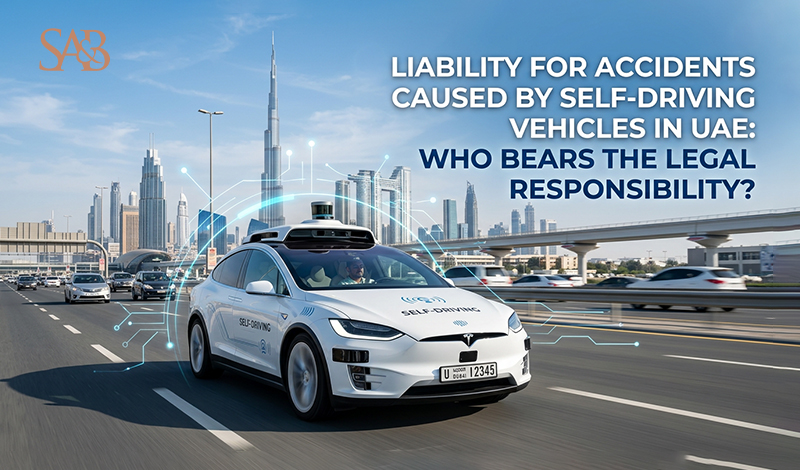

The increasing number of autonomous or self-driving vehicles in UAE raises an important legal question; who is liable when a vehicle operating without human control causes an accident? Generally, the road-traffic liability is based on the conduct of a human driver. However, in case of accidents caused by the autonomous vehicles, liability is upon certain persons including the vehicle operator, manufacturer, software developer, maintenance provider and other persons in the technological system.
UAE has adopted a progressive legislation on this matter. While federal traffic legislation recognises and regulates autonomous vehicles, Dubai has introduced a comprehensive law stating specific rules concerning their operation and civil/criminal liability.
UAE Federal Law on Traffic Regulations
The law relating to traffic regulation in UAE is Federal Decree-Law No. (14) of 2024 Regulating Road Traffic. This law applies to vehicles, drivers and pedestrians using roads and provides the detailed law for road traffic in UAE. It also contemplates the licensing and regulation of modern vehicle technologies, including self-driving vehicles.
The law must be read together with the Federal Decree-Law No. (25) of 2025 promulgating the Civil Transactions Law, which came into force on 1 June 2026. The new Civil Transactions Law contains general principles governing liability for harmful acts.
Article 245 expressly provides that its rules apply subject to liability provisions contained in special legislation. Article 246 establishes the general principle that an act causing harm to another creates an obligation to compensate for the resulting damage. Accordingly, where a specific autonomous-vehicle law applies, that special legislation will take priority.
Dubai’s Specific Autonomous Vehicle Law
Dubai has established a more specific rule through Law No. (9) of 2023 Regulating the Operation of Autonomous Vehicles in the Emirate of Dubai.
The most significant provision is Article 14, which directly addresses civil liability. It provides that the Operator is liable for compensating any damage to property or harm to individuals caused by an Autonomous Vehicle. Importantly, the Operator holds the right to seek remedy against the person actually responsible for the damage under the general rules of liability.
This creates a practical two-level liability structure. Firstly, the injured person may pursue compensation against the Operator. Secondly, the Operator may subsequently recover the amount from the manufacturer, software provider, maintenance provider or another person actually responsible for the accident, where the evidence establishes such responsibility.
Who is an “Operator” under the law?
The concept of the Operator is related to autonomous-vehicle liability. The law does not simply ask who was sitting in the vehicle at the time of the accident. Instead, liability is connected to the person or entity legally authorised to operate the autonomous vehicle.
This is particularly important for autonomous taxis, commercial transport services and fleet operators. A passenger who merely occupies an autonomous vehicle would not ordinarily be treated as its driver.
At the same time, Article 13 of Law No. (9) of 2023 imposes obligations on passengers, including compliance with safety requirements and a prohibition against tampering with the vehicle’s systems or software.
Manufacturer and Software Liability
Although the Operator bears primary civil responsibility for the accident, this does not necessarily mean that the Operator is ultimately responsible for the accident.
An accident may result from a manufacturing defect, defective sensor, software malfunction, inadequate mapping, cybersecurity failure or improper maintenance. In such circumstances, the Operator may exercise its right of recourse against the party actually responsible.
The technical evidence may therefore become conclusive in determining the ultimate liability. Vehicle logs, sensor data, software versions, maintenance records, GPS information and system-generated accident data may all become relevant in determining the liability.
Dubai’s Executive Council Resolution
Dubai’s Executive Council Resolution No. (14) of 2026 has further developed the law relating to the autonomous-vehicle. It establishes three operational phases:
- verification of data and maps,
- operation with a Safety Operator, and
- operation without a Safety Operator.
The RTA determines when each phase begins and ends. The Resolution also regulates personal use of autonomous vehicles. An owner may activate the autonomous driving system only during the authorised operational phase and after obtaining RTA approval. Where an owner activates the system without the required approval, the owner must bear legal liability for damage arising from that unauthorised activation.
Thus, unauthorised activation or non-compliance with RTA requirements may further affects the liability.
Role of RTA
It is important to differentiate regulatory responsibility from civil liability. Under Article 14(b) of Dubai Law No. (9) of 2023, the RTA is not liable to third parties for damage resulting from the use of autonomous vehicles.
The RTA’s role is primarily regulatory, supervisory and licensing-related and approval of an autonomous vehicle does not by itself make the RTA responsible for an accident.
Conclusion
UAE’s autonomous-vehicle law marks a change from the driver-based liability towards operator-based and technology-sensitive liability. In Dubai, Article 14 of Law No. (9) of 2023 provides that the Operator is responsible for compensating damage caused by an autonomous vehicle, while retaining the right of get remedy against the party actually responsible.
The Civil Transactions Law emphasises the general principle that harm gives rise to an obligation to compensate, subject to special legislation. As autonomous vehicles become more widespread, disputes will increasingly focus on software defects, maintenance, cybersecurity, regulatory compliance and the preservation of digital evidence.
At Ayesha AlDhaheri Advocates & Legal Consultants, we provide comprehensive legal advice and representation in matters involving traffic offences, civil liability, insurance disputes, and compensation claims arising from road accidents. If you require legal guidance or representation, our experienced team is here to assist you.