
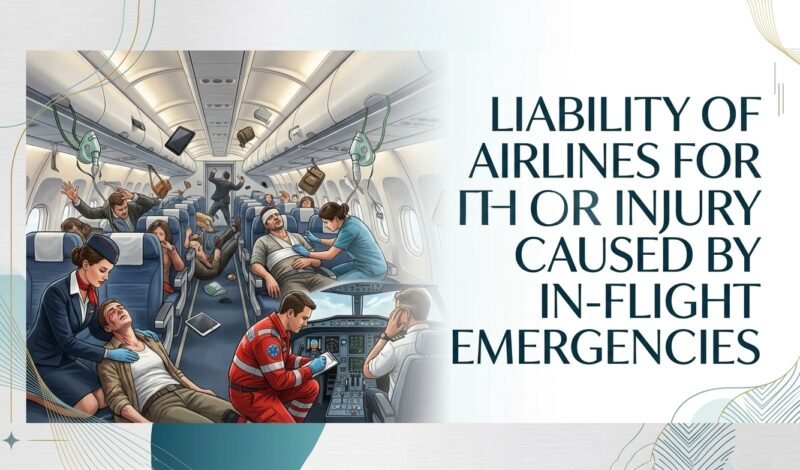

Air travel is recognised as one of the safest forms of transportation. However, in-flight emergencies such as engine failure, fire, severe turbulence, sudden loss of cabin pressure, medical emergencies and emergency landings can cause serious risks and life threats to passengers and airline crews. When such an emergency results in death or personal injury, an important legal question arises is that, to what extent should an airline be held liable for the resulting harm?
The answer depends not merely on the occurrence of an emergency, but also on its cause, the conduct of the carrier, the law, and the relation between the emergency and the injury suffered.
The Airline’s Duty of Care
An airline owes passengers a fundamental duty to transport them safely to their intended destination. This obligation extends beyond the ordinary operation of the aircraft and includes taking reasonable measures to protect passengers when an unexpected emergency arises.
Airlines are therefore expected to maintain aircraft properly, comply with aviation safety regulations, employ appropriately qualified personnel, conduct required safety checks and establish emergency procedures. Where an injury occurs because the carrier failed to comply with these obligations, the question of negligence or other forms of legal liability may arise.
However, the mere occurrence of an emergency does not automatically establish negligence. Aviation involves circumstances that may develop suddenly and may not reasonably be capable of prevention.
Liability for Death or Bodily Injury
The law governing airline liability for death or bodily injury depends on whether the journey is international or domestic.
- For international carriage, the Montreal Convention, 1999 provides the rules governing carrier liability for passenger death or bodily injury. Under this convention, a carrier may be liable where a passenger suffers death or bodily injury caused by an accident that took place on board the aircraft or during the relevant operations of embarking or disembarking. However, the legal assessment consequently involves questions concerning the existence of an accident, the location of the event and the causal connection between that event and the injury.
- For domestic flights, liability is generally governed by the national aviation and civil laws of the country concerned. In UAE, claims arising from domestic air transportation may be considered under the UAE aviation legislation, civil liability principles, and related contractual obligations. The circumstances of the incident, the carrier’s conduct, and the statutory provisions determine the extent of liability.
Emergencies and the Question of Negligence
In this context, an important distinction must be made between an emergency that could not be prevented and one that was caused by the airline’s actions or failure.
For instance, an unexpected natural event may create risks despite appropriate safety procedures. In contrast, an engine failure associated with inadequate maintenance may raise questions concerning whether the carrier fulfilled its regulatory and contractual obligations.
Similarly, where turbulence results in passenger injury, the legal assessment may require examination of whether the airline and crew had appropriate information concerning weather conditions and whether reasonable precautions were taken.
Thus, the existence of an emergency alone does not necessarily determine liability. The surrounding circumstances and the conduct of the carrier must also be examined.
Role of Conduct of Pilot and the Crew
The actions of pilots and cabin crew can become important when determining liability following an in-flight emergency. Aviation regulations require flight crews to undergo specialised training for emergency situations, including evacuation, fire response, medical emergencies and abnormal flight conditions.
If the crew responds appropriately and follows established emergency procedures, the airline may argue that reasonable measures were taken to protect passengers. On the other hand, failure to follow such procedures or unreasonable conduct during an emergency may become relevant for the determination of liability.
Medical Emergencies and Passenger Injury
Not every in-flight injury result from a technical failure or accident. Passengers may suffer serious medical emergencies such as cardiac events, respiratory problems or other sudden illnesses during a flight.
In such circumstances, questions may arise regarding the airline’s responsibility to provide reasonable assistance. Cabin crew generally receive training in basic emergency response, and aircraft may carry medical equipment appropriate to the applicable regulatory requirements.
The legal issue may therefore concern whether the airline and its personnel acted reasonably in response to the passenger’s condition rather than whether the airline caused the underlying medical event.
Conclusion
Airline liability for death or injury arising from in-flight emergencies requires a careful examination of aviation safety obligations, applicable international or domestic law, the nature of the emergency and the conduct of the carrier and its employees.
An airline should not necessarily be held responsible merely because an emergency occurred. At the same time, the existence of an emergency cannot by itself absolve a carrier where the harm resulted from inadequate maintenance, failure to follow safety requirements, negligence or an unreasonable response.
Ultimately, the law seeks to balance two important interests: protecting passengers who suffer death or injury during air transportation while recognising the practical realities and unavoidable risks associated with emergency situations in aviation.